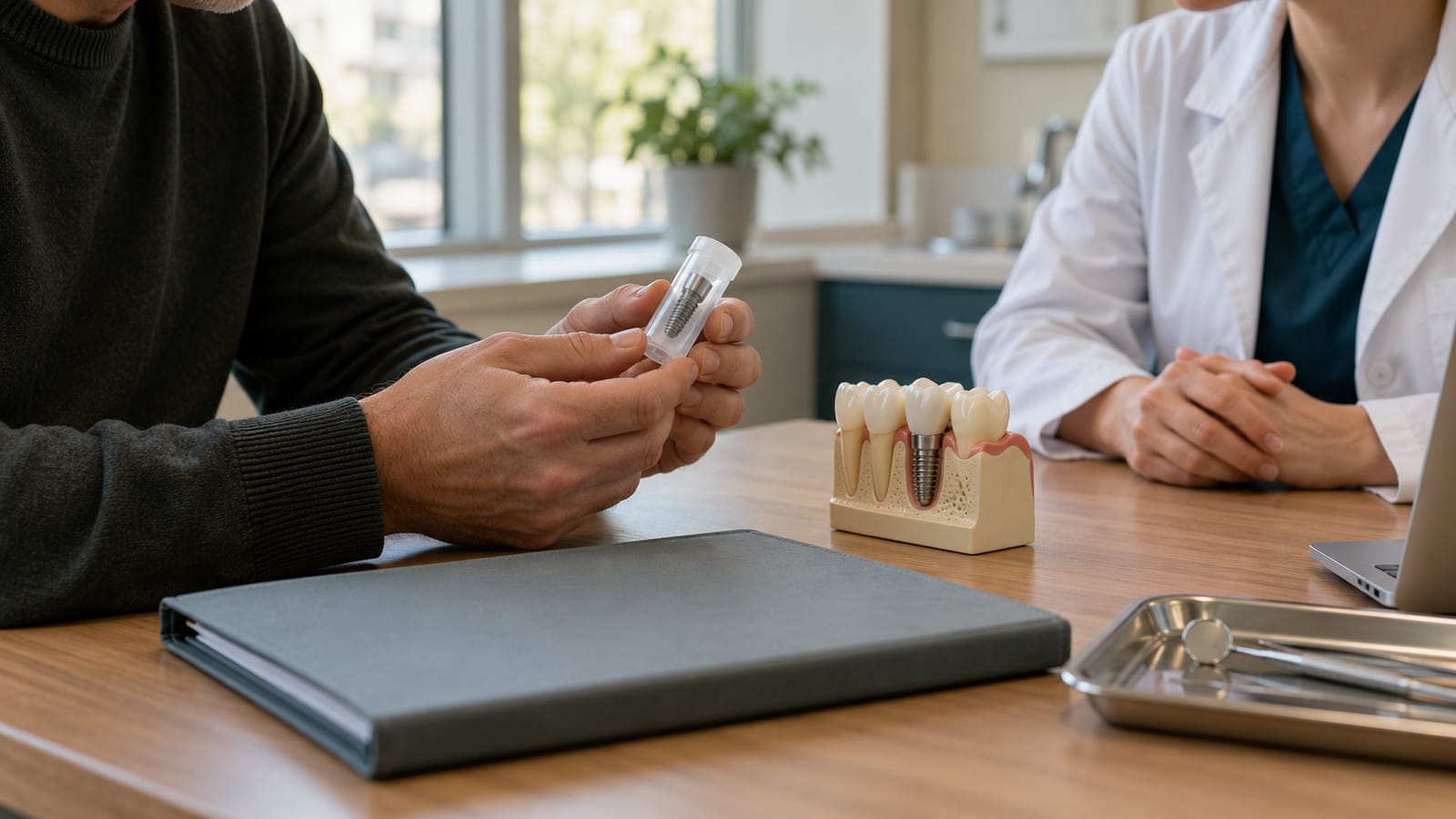
Dental implants gone wrong in Turkey require examining what treatment was agreed, what was performed and why the implant or restoration failed. Failure alone does not establish negligence. A claim may concern defective service, a promised prosthetic result, lack of informed consent or injury caused by faulty care; each requires its own facts and legal conditions (6502 sayılı Tüketicinin Korunması Hakkında Kanun m.13, m.14; 6098 sayılı Türk Borçlar Kanunu m.49; Hasta Hakları Yönetmeliği m.31).
This guide concerns a foreign patient who purchased treatment at a private provider. Public healthcare follows a different route, addressed below. It explains how to assemble the treatment and product records, preserve evidence before further work, and identify possible remedies without assuming that an unsuccessful implant guarantees a refund.
1. Dental Implants Gone Wrong in Turkey: Failure, Negligence or a Contractual Defect?
Dental implants gone wrong in Turkey can raise different questions about the surgical treatment and the restoration promised. A works contract involves undertaking to produce a work for a price. A mandate concerns undertaking another person’s business or act, with duties of loyalty and care. The contract and the service undertaken must be examined; the procedure’s name does not classify every part of an implant treatment automatically (6098 sayılı Türk Borçlar Kanunu m.470, m.471, m.502, m.506).
If the patient reports pain, instability, an unusable restoration or the need for removal, the report identifies what requires investigation. It does not identify the clinical cause or establish the responsible person. Technical assessment may require an expert opinion. For a tort damages claim, the injured person bears proof of the damage and the wrongdoer’s fault (Hukuk Muhakemeleri Kanunu m.266; 6098 sayılı Türk Borçlar Kanunu m.49, m.50).
Contractual conformity is a separate issue. Consumer law defines defective service by the agreed and objectively required qualities and by representations made by the provider. The provider owes performance conforming to the contract. This can make the treatment plan and the advertised materials relevant alongside clinical care, while damages for non-performance have their own fault rule (6502 sayılı Kanun m.13, m.14; 6098 sayılı Türk Borçlar Kanunu m.112).
The Turkey teeth guide addresses crowns and veneers, including promised veneers replaced by crowns. This implant guide instead focuses on the implant treatment, product identity, staged agreement and evidence affected by removal or replacement.
2. Dental Implants Gone Wrong in Turkey: What Did the Treatment Plan Promise?
Dental implants gone wrong in Turkey should first be compared with the actual quotation, treatment plan and later changes. Keep the description of the implant system, the sites to be treated, the proposed restoration, any preliminary procedures included, the stated operator and the visits included in the price. Distinguish an express undertaking from a general image or an estimate awaiting examination (6502 sayılı Kanun m.13).
Record the stages separately. A quote for placement, a later restoration and follow-up does not prove that all stages occurred or that the same organisation performed them. Match dated notes and invoices to each stage. This helps determine whether the complaint concerns incomplete performance, a disputed material or brand, the promised restoration, or care during a particular intervention.
The provider can escape statements originating elsewhere only by proving one of the specified matters: that it was unaware and could not be expected to know of them, that they were corrected before contracting, or that they had no causal connection to the decision to contract. Preserve the exact wording and its date rather than assuming all advertising is either binding or irrelevant (6502 sayılı Kanun m.14).
A commercial guarantee should be kept with the agreement. It may describe an additional undertaking or conditions for returning to the provider, but it should not be substituted for the legal tests on defects, damage or limitation. The consumer limitation provision expressly preserves a longer period laid down by law or contract; whether the particular guarantee establishes one requires reading its terms (6502 sayılı Kanun m.16).
3. Dental Implants Gone Wrong in Turkey: Consent to Placement and Later Changes
Dental implants gone wrong in Turkey require checking what was explained before the intervention, not merely whether a signature appears on a form. Information must cover who will perform the intervention, where and how it will occur, alternatives, benefits and risks, possible complications and access to further help where needed. It must be given in a way the patient can understand (Hasta Hakları Yönetmeliği m.15, m.18).
Keep the consent form, the explanation supplied and any messages about changes to the proposed treatment. Where the regulation requires a consent form, it is signed in two counterparts and one is provided to the patient or legal representative. Consent is not unlimited permission to replace the proposed intervention with a different one (Hasta Hakları Yönetmeliği m.26, m.31).
The scope rule includes routine steps necessarily continuing the agreed intervention. Extension without further consent has a specific medical-necessity exception where otherwise an organ would be lost or cease functioning. Apply the actual condition, rather than describing every change during surgery as automatically authorised (Hasta Hakları Yönetmeliği m.31).
4. Dental Implants Gone Wrong in Turkey: Which Records Should You Request?
Dental implants gone wrong in Turkey require the clinical file alongside the commercial documents. The patient can inspect health records and obtain a copy directly, through a proxy or through a legal representative. A request should identify the patient, dates and provider and specify the relevant documents held there (Hasta Hakları Yönetmeliği m.16).
Depending on what was performed and recorded, ask for the assessment and treatment plan, imaging, operative notes, consent forms, prescriptions, follow-up entries and any product identifiers or cards issued. A request for a category does not prove that the document exists. An implant passport is a useful description for a product card in some offers; the cited access rule does not create a universal passport obligation.
The dental regulation separately requires all medical devices and consumables used at the facility to be registered in the Ministry’s Product Tracking System, with individual notifications through that system. Compare any identifiers provided with the agreement and records. A missing patient card is not, by itself, proof that the product was unregistered (Ağız ve Diş Sağlığı Hizmeti Sunulan Özel Sağlık Kuruluşları Hakkında Yönetmelik m.19/9).
The facility must issue a receipt or invoice and an annex identifying the detailed health service and unit prices. Health tourism rules additionally require the charged medicines and consumables list, paid test and imaging results and externally purchased prescriptions to be supplied free on request, with the stated exception for forensic originals. The intermediary supplies its own itemised accommodation, transport, transfer, interpreting and consultancy charges (Ağız ve Diş Sağlığı Hizmeti Sunulan Özel Sağlık Kuruluşları Hakkında Yönetmelik m.19/11; Uluslararası Sağlık Turizmi ve Turistin Sağlığı Hakkında Yönetmelik m.12).
The medical records request guide explains application methods and complaint periods. Do not confuse access to the file with proof that the treatment was negligent. In proceedings, document production follows its own conditions and the court assesses any non-production accordingly (Hukuk Muhakemeleri Kanunu m.219, m.220).
5. Dental Implants Gone Wrong in Turkey: Evidence Before Removal or Revision
Dental implants gone wrong in Turkey considered for further treatment require preserving the existing condition where possible. A patient may obtain a second medical opinion. Keep the new clinician’s findings, dated images, recommended intervention and reasons, together with the original treatment file (Hasta Hakları Yönetmeliği m.18).
Photos and messages can be documents in civil proceedings. They may help establish the timing, the representation and the exchanges about aftercare, but a photograph does not settle technical fault or causation. Those issues can require an expert assessment (Hukuk Muhakemeleri Kanunu m.199, m.266).
Civil evidence preservation is available for facts to be used in an existing or future case and requires a legal interest. A risk that the evidence will disappear or become substantially harder to present can meet that condition. Before proceedings, the request may go to the court that would hear the main case or the local civil court identified by the provision; after proceedings, the court hearing the case deals with it (Hukuk Muhakemeleri Kanunu m.400, m.401).
Removal or revision may change the condition later examined. Preserve the reason for that treatment and whatever records can be obtained; the procedural option is not an instruction to delay clinically necessary care. Similar concerns arise before revision in the rhinoplasty guide, though the procedures and clinical evidence differ.
6. Dental Implants Gone Wrong in Turkey: Must You Return for Repair?
Dental implants gone wrong in Turkey do not produce a single mandatory remedy. For defective consumer service, the consumer may choose re-performance, free repair of the resulting work, proportional price reduction or rescission. Repair and re-performance cannot be insisted on where they create disproportionate difficulties under the statutory assessment. Costs arising from exercising a selective right fall on the provider (6502 sayılı Kanun m.15).
For a defective work, rescission requires a defect or contractual departure serious enough that the work cannot be used or accepted in fairness. Price reduction and repair have their own conditions, including the restriction on excessive repair expense. General damages remain reserved. These conditions should be checked before treating a full refund as inevitable (6098 sayılı Türk Borçlar Kanunu m.475).
A clinic’s offer to redo the work is relevant to the dispute, but does not itself determine the patient’s statutory remedy. Document the proposed intervention, who would perform it, its cost and any terms attached. A refusal to return does not establish every defence for the clinic; the factual reason and legal basis still matter.
Where bodily injury is claimed, treatment costs, loss of earnings and other listed bodily losses require examination against the liability basis. Non-pecuniary damages for harm to bodily integrity depend on the circumstances and judicial assessment. An invoice for replacement treatment abroad supports the file; it is not proof that the whole expense must be paid (6098 sayılı Türk Borçlar Kanunu m.49, m.50, m.54, m.56, m.112).
7. Dental Implants Gone Wrong in Turkey: The Provider, Agency and Complaint Route
Dental implants gone wrong in Turkey require identifying the entity that undertook treatment, the treating dentist and any intermediary. The health facility and intermediary are responsible according to the type of service supplied, with complications and poor medical practice included in the regulatory scope. That does not make every intermediary responsible for every clinical act (Uluslararası Sağlık Turizmi ve Turistin Sağlığı Hakkında Yönetmelik m.6).
Facility licensing and international health tourism authorisation are separate questions. The dental provider starts accepting and treating patients after its operating permit is issued; a facility or intermediary carrying out international health tourism also requires the relevant authorisation. The Ministry’s authorised-provider lists help identify current status. A current list alone does not establish historical authorisation on a past treatment date (Ağız ve Diş Sağlığı Hizmeti Sunulan Özel Sağlık Kuruluşları Hakkında Yönetmelik m.14; Uluslararası Sağlık Turizmi ve Turistin Sağlığı Hakkında Yönetmelik m.5).
A private consumer transaction falls within consumer-court jurisdiction, with the committee route governed by dispute value and the applicable annually adjusted threshold. Consumer-court disputes covered by mandatory mediation require that step first; committee disputes and the other statutory exceptions are excluded. The Ministry of Trade’s committee information page explains the administrative application channel (6502 sayılı Kanun m.3, m.68, m.73, m.73/A).
A claim arising from a public administration’s healthcare activity is a separate full-remedy route with a prior application requirement. It should not be presented as the same consumer procedure. The private hospital malpractice guide discusses the distinction (İdari Yargılama Usulü Kanunu m.2/1-b, m.13).
8. Dental Implants Gone Wrong in Turkey: Notice, Deadlines and a Claim from Abroad
Dental implants gone wrong in Turkey require identifying the legal basis before calculating a deadline. Defective consumer services generally have two years from performance, unless a longer statutory or contractual period applies; limitation provisions do not apply where the defect was concealed by gross fault or deceit (6502 sayılı Kanun m.16).
For defective works other than immovable structures, the period is two years from delivery, and twenty years where the contractor is grossly at fault. Inspection and notification are separate: the work must be examined as soon as the ordinary course permits and defects notified within a reasonable time; a later-emerging defect must be notified without delay. Acceptance and failure to inspect or notify have consequences subject to the provision’s exceptions (6098 sayılı Türk Borçlar Kanunu m.474, m.477, m.478).
Mandate claims have a five-year rule, with the period starting when the claim becomes due. Tort damages generally have two years from knowledge of the damage and liable person and ten years from the act, subject to a longer applicable criminal limitation. A booking guarantee or the day the patient became dissatisfied should not replace those starting events (6098 sayılı Türk Borçlar Kanunu m.147/5, m.149, m.72).
For a patient abroad, governing law and jurisdiction must be assessed separately. Contractual choice of law and the closest-connection rule apply within their scope. The consumer provision excludes services necessarily supplied outside the patient’s habitual residence, subject to its package-tour exception. Turkish international jurisdiction follows domestic venue rules, and foreign-court clauses have separate conditions (5718 sayılı Milletlerarası Özel Hukuk ve Usul Hukuku Hakkında Kanun m.24, m.26/4, m.40, m.47).
The practical first steps are:
- Identify the provider and each treatment stage from the agreement and itemised invoice, then request the clinical and product records (Hasta Hakları Yönetmeliği m.16; Uluslararası Sağlık Turizmi ve Turistin Sağlığı Hakkında Yönetmelik m.12).
- Preserve the reported problem and any proposed removal or replacement, considering evidence preservation where its conditions exist (Hukuk Muhakemeleri Kanunu m.400).
- Have the claim basis, notification and applicable periods examined before selecting the committee, mediation or court route (6502 sayılı Kanun m.68, m.73/A; 6098 sayılı Türk Borçlar Kanunu m.474, m.477).
A person with procedural capacity may conduct the case personally or through an appointed representative. A lawyer must submit the required power of attorney; representation does not guarantee that no examination or personal attendance will be required. The foreign patient malpractice guide explains the common framework for treatment disputes (Hukuk Muhakemeleri Kanunu m.71, m.76).
Frequently Asked Questions
Does a failed dental implant in Turkey automatically prove negligence?
No. Tort liability requires a wrongful and faulty act causing damage, and the injured person bears proof of damage and fault. A contractual defect is examined separately against the agreed and objectively expected service. Technical questions may require an expert opinion; failure alone does not decide them (6098 sayılı Türk Borçlar Kanunu m.49, m.50; 6502 sayılı Kanun m.13; Hukuk Muhakemeleri Kanunu m.266).
Is every dental implant agreement a works contract?
No classification follows automatically from the word implant. A works contract involves undertaking to produce a work, while a mandate involves undertaking another person's business or act with a care obligation. Examine the promised prosthetic result, surgical treatment and actual agreement before selecting the applicable remedies and periods (6098 sayılı Türk Borçlar Kanunu m.470, m.502, m.506).
Can I request my implant records after leaving Turkey?
Yes. The patient may inspect the health file and obtain a copy directly, through a proxy or through a legal representative. Health tourism rules also require specified billing, material and imaging documents to be supplied free on request, with the stated exception for forensic originals. Identify treatment dates and the documents sought (Hasta Hakları Yönetmeliği m.16; Uluslararası Sağlık Turizmi ve Turistin Sağlığı Hakkında Yönetmelik m.12).
Must every clinic give me an implant passport?
The rules discussed here do not establish a universal document called an implant passport. Request any product card actually issued and the implant identifiers held in the file. The dental regulation separately requires products to be registered in the Ministry's Product Tracking System and individual notifications to be made; that is not the same as a patient passport obligation (Ağız ve Diş Sağlığı Hizmeti Sunulan Özel Sağlık Kuruluşları Hakkında Yönetmelik m.19/9).
Can I have the implant removed elsewhere before a claim?
Further treatment elsewhere does not automatically extinguish every claim, but removal may change important evidence. Keep the new clinician's findings and the reason for removal. Civil evidence preservation requires a legal interest, including a risk of losing evidence or substantially greater difficulty presenting it. The procedural option does not direct a patient to delay necessary care (Hukuk Muhakemeleri Kanunu m.400).
Can I demand a refund rather than return for another procedure?
A defective consumer service permits choosing between re-performance, repair, proportional price reduction and rescission, subject to the statutory conditions and the disproportionate-difficulty restriction on repair or re-performance. A works-contract rescission has its own seriousness requirement. An offer to redo treatment does not by itself decide which remedy is available (6502 sayılı Kanun m.15; 6098 sayılı Türk Borçlar Kanunu m.475).
How long do I have to claim for dental implants gone wrong?
There is no single implant deadline. Defective services generally have two years from performance, with longer-period and concealment exceptions. Defective works other than immovable structures have two years from delivery and twenty years for gross fault. Mandate and tort grounds follow different rules; notice and limitation are also separate (6502 sayılı Kanun m.16; 6098 sayılı Türk Borçlar Kanunu m.478, m.147/5, m.72).
Can a dental implant claim be conducted while I live abroad?
A person with procedural capacity may conduct proceedings personally or through an appointed representative, and a lawyer must submit the required power of attorney. Representation does not guarantee that no examination or personal attendance will be required. Turkish international jurisdiction depends on domestic venue rules; governing law is a separate question (Hukuk Muhakemeleri Kanunu m.71, m.76; 5718 sayılı Kanun m.40).